
The Invisible Kaleidoscope, Wandering Truth, and the Open Totality
This essay develops the concept of the Diagonal Path in the philosophy of Alexis Karpouzos as an expression of Time itself—not linear, not circular, but spiral-helical, three-dimensional, and ceaselessly transforming. It argues that the Diagonal Path does not merely traverse oppositions but constitutes the very manner in which Time—unified and three-dimensional, manifesting simultaneously synchronically, diachronically, and panchronically, locally, planetarily, and cosmically—coordinates, unites, and differentiates every existent. The second section develops the image of the world as an invisible kaleidoscope, in which every thought, system of ideas, theology, metaphysics, ideology, and act, from early humans to the present, constitutes a fragment-totality—a fragmentary perspective of the Open Totality that no single fragment can exhaust.
The Diagonal Path and Three-Dimensional Time
There is a question that remains almost always unspoken in philosophical analyses: what is it that traverses oppositions, coordinates them without erasing them, unites them without identifying them, differentiates them without isolating them? What is that movement which is always “between,” which never stops, which has neither beginning nor end, which keeps tension alive rather than annihilating it?
The answer—if the question is heard in its depth—is: Time. Not time as a mere succession of moments, not time as the number of motion, not time as a psychological flow of sensations, but Time as a fundamental ontological force that coordinates every existence through diagonal movement, Time that “passes through” opposites without permanently dwelling in either.
This identification of the Diagonal Path with Time is not arbitrary—it is necessary: every opposition is an opposition in time and through time. Being and Becoming, the One and the Many, the Finite and the Infinite do not appear simultaneously as an undifferentiated presence. They appear successively and simultaneously, locally and universally, as moment and as eternity, because Time holds them in this perpetual tension. Time is the Diagonal Path of the world itself.
The reflection unfolded in this essay understands time as unified and three-dimensional—three dimensions that are not simply three stages of a sequence, but three modes of presence that mutually contain one another: each carries the other two within itself. This three-dimensionality is the ontological foundation of the Diagonal Path as time.
The first dimension is synchronicity: the simultaneous coexistence of all that manifests within a given broader moment—in a civilization, a world, an ecosystem of ideas. Synchronicity does not concern only events occurring “now”; it concerns the simultaneous presence of all the forces, tendencies, oppositions, and coordinations that constitute a living whole. In every moment, the ancient and the new, the concrete and the abstract, the individual and the common are simultaneously present—and these do not merely succeed one another, but coexist, mutually attuned, within synchronic presence.
The second dimension is diachronicity: movement through time as change, development, transformation, loss, and recovery. Diachronicity is the dimension of narrative—of how things become what they are through their course. Yet diachronicity is not a simple linear sequence: every diachronic movement carries within it its synchronic gravity—the way in which that which moves through time carries with it the entire simultaneous presence from which it begins.
The third dimension is panchronicity: the sense—or deeper intuition—that every moment carries the whole of time within itself. The “now” is not a closed point but a field into which the whole past converges and from which the whole future returns as possibility. Augustine called this “distentio animi”—the distension of the soul. Proust rendered it with incomparable fullness as a “search for lost time” that proves not to have been lost. Karpouzos articulates it as a meta-ontological category: in panchronic Time, every moment is the whole world focused into a point.
Spiral and Helix: The Geometry of Transformation
Every civilization has developed a geometry of time—a way of imagining what time does. Two great traditions predominate: the linear and the circular. The linear—dominant in Western modernity—understands time as a straight movement from beginning to end: from Creation to Eschatology, from the Primitive to Civilization, from Past to Future. This linear geometry contains a teleology: each moment has meaning only as a stage toward an End.
Circular geometry—dominant in many Eastern traditions—understands time as return: movement completes itself, returns, repeats. This circular geometry contains an invariant structure: behind superficial changes, the world eternally repeats patterns. Nietzsche carried this to an extreme with the “eternal recurrence”—a circularity so radical that it cancels every notion of linear progress.
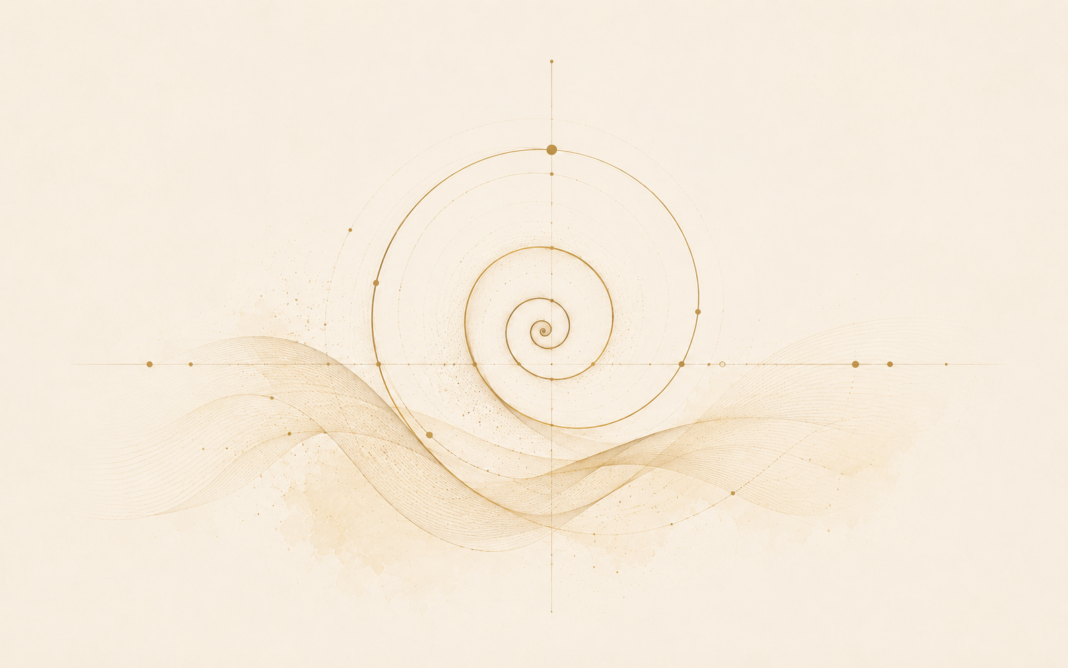
The spiral and the helix open a third path. On a plane, the spiral moves both circularly and centrifugally—it returns, but to a different point. Every “return” is a return on a new level—a new perspective, a new range. The helix, the three-dimensional form of the spiral, adds the dimension of depth: it moves at once circularly, outwardly, and more deeply.
This is the geometry of Time for Karpouzos—and therefore the geometry of the Diagonal Path as Time: a helical movement that neither merely repeats nor abandons—it transforms. Every moment carries with it what preceded it, but in a new configuration. Every “return” to a position occurs from a different height—a new viewpoint, a new understanding, a new possibility. Helical movement combines linear movement (it does not remain where it was), circular return (it does not abandon what it was), and deeper immersion (it moves into depth).
Helical movement is not merely a geometric image—it is an ontological category: it describes the manner in which the world transforms itself. Every transformation carries within it the memory of what was and the prospect of what is becoming—but it is neither mere repetition nor rupture. It is a diagonal movement that respects the past without being bound by it, that embraces the future without exhausting it in a plan.
The helix also provides an image for the relationship among the three dimensions of time. Imagine a three-dimensional helix: each point is defined by its angle (synchronicity—where it is “now” in the cycle), its radius (diachronicity—how far it has developed from the beginning), and its height (panchronicity—what depth it has acquired). The three dimensions are not independent—every point on the helix embodies all three simultaneously. And the diagonal line traced by the helix cannot be reduced to any one of them separately: it is their very movement in harmonious interdependence.
It is no accident that spiral and helical forms appear throughout the natural world: in the galaxy that turns in spiral form, the shell that grows spirally, DNA that encodes life in a double helix, the vortex whose force gathers spirally, and the human ear that hears through spiral structures. This recurrence reflects something profound about the nature of self-organization in the world.
Karpouzos draws from this observation an ontological principle: helical movement is the way life, matter, and thought self-organize—preserving unity (the helix is a single curve) while developing multiplicity (each point is unique), coordinating oppositions (center/periphery, stability/change, repetition/innovation) without annihilating them.
Time as Diagonal Path unites the local and the planetary, the momentary and the eternal, the individual and the universal—not through leveling but through coordination. Every local event resonates throughout planetary and cosmic time; every moment of individual existence reflects the whole of human history. Yet this reflection does not erase particularity; on the contrary, it deepens it: precisely because every local event carries within itself its planetary dimension, it is richer, deeper, more meaningful than it would be in isolation.
This simultaneous locality and universality is not a paradox—it is a structure. In helical movement, every point is simultaneously local (it occupies a specific position) and part of the universal movement (it is defined by its relation to the whole trajectory). The same applies to human time: every life is simultaneously local (lived by a particular person, at a particular time, in a particular place) and universal (participating in planetary and cosmic time, which belongs to no one in particular).
But the Diagonal Path as Time does not only unite—it also differentiates. Every helical moment is unique—it never repeats in exactly the same form. Time, precisely because it moves helically, continually produces new differences: new forms, new patterns of thought, new forms of life. This differentiation does not sever things from their coherence; it is the very form of coherence of a world that is alive.
Leibniz intuited something analogous: there are no two identical leaves in the world—everything is uniquely what it is. For Leibniz, however, this uniqueness was grounded in divine creation. For Karpouzos, it is grounded in the helical structure of Time: the uniqueness of everything is not a gift of God but a structural characteristic of a world moving helically—always returning yet always to a new position, always recognizable yet always transformed.
The third function of Time as Diagonal Path is coordination—and this is perhaps the most difficult element to interpret. Time coordinates: it holds together the local and the planetary, the momentary and the eternal, the individual and the common—not through an external law or institution, but through the very dynamics of helical movement.
This coordination is not domination: Time does not “decide” what will happen, does not “determine” the value of things, does not “impose” any teleology. It is closer to what systems theory calls “emergent order”: coherence arising from the interaction of multiple elements without central control. Time as Diagonal Path coordinates in the way an ecosystem coordinates itself—not by following central instructions, but by developing balance from within, from the structure of interdependence.
The Invisible Kaleidoscope and Wandering Truth
The kaleidoscope is a simple yet profound geometric instrument: through a system of mirrors, a small number of fragments of colored glass produces infinitely varied symmetrical images. Every slight movement changes the entire image. Each fragment, depending on its position, participates differently in the overall pattern. The totality is not a fixed design but a perpetually transforming concord of fragments.
Karpouzos uses this image to describe the world of ideas, forms of thought, and civilizations: the world is an invisible kaleidoscope in which every system of ideas, every theology, every metaphysics, every ideology, every epistemology, and every act—from the first markings made by early humans in caves to contemporary computers—constitutes a fragment of colored glass. Each fragment has its own chromatic uniqueness. Each contributes to the overall image in a way without which that image could not exist. And no fragment is “the” image by itself.
The concept of the “fragmentary perspective-totality” introduced by Karpouzos is philosophically dense and requires deeper consideration. Every system of thought is simultaneously fragmentary AND a totality—and this is not a contradiction.
It is fragmentary because it does not contain the whole truth, does not exhaust the whole world, and cannot claim definitive and complete knowledge. Every theology—from the animistic systems of early humans to contemporary theology—touches something true about the human relation to transcendence, but never touches it in its entirety. Every metaphysics—from Parmenides to Heidegger—digs toward the root of Being, yet never reaches a “bottom,” which proves to be groundless. Every ideology—from liberalism to anarchism—expresses a real value, a real human need, but cannot claim exclusive access to the common good.
At the same time, it is a totality because every system of thought is not merely a piece of a larger truth—it is a complete mode of relating to the world. The early human who engraves an animal on rock does not express “primitive” thought waiting to be completed by science; that act expresses a totality of relation to the world: aesthetic, ethical, ritual, spiritual, cognitive. This primordial totality is not superseded by science—it is replaced by another totality, different, equally fragmentary, equally complete.
The invisible totality of the kaleidoscope is located in no particular fragment—and yet permeates them all. What Karpouzos calls “wandering truth” is precisely this: Truth—with a capital T—does not permanently reside in any system. It wanders among them, expresses itself through their entire spectrum, emerges in their encounter. It is wandering because it cannot settle—settlement would mean petrification, dogma, ideology. It remains always in motion, helically, precisely because the world it expresses is itself helical.
This position opposes both relativism and dogmatism in the most radical way. Against dogmatism—which claims that one tradition possesses Truth—Karpouzos answers: Truth wanders; it does not permanently dwell in any one place. Against relativism—which claims that every tradition has “its own truth” and that these truths cannot be compared—Karpouzos answers: truth is not a subjective illusion. There is a truth that exists, moves, and reveals itself—but in fragments, never in its entirety, never in a single fragment.
The first human “fragments” in the kaleidoscope of truth appeared hundreds of thousands of years ago. The cave paintings of Lascaux, Neanderthal rituals, the earliest burials with pigments—all testify that early humans did not live merely biologically. They lived symbolically: they saw in things something beyond their immediate usefulness, felt themselves part of a context that exceeded them, and communicated with that context through ritual, image, and story.
These first fragments are not “primitive” in a reductive sense—they are the dawn of the human capacity for symbolism, aesthetics, and spirituality, a capacity that would develop, transform, and become enriched but would never be wholly surpassed. Every contemporary technology, every scientific system, every philosophical tradition carries within it—as helical memory—this primordial human capacity. Beethoven and Lascaux are on the same helix—on different turns, but within the same movement.
The great theological traditions—Hinduism, Buddhism, Taoism, Judaism, Christianity, Islam, African, Indigenous American, and Oceanic traditions—constitute immense fragments in the kaleidoscope. Each touches something true and profound concerning the human relation to transcendence, time, mortality, and meaning. And each touches it in its own unique, irreducible way.
Buddhism touches groundless openness—sunyata—with incomparable acuity. The Hindu tradition touches totality as living presence through inexhaustible imagery. Taoism touches the invisible rhythm—the Tao—that cannot be said but can be lived. Christianity touches the fundamental value of each unique existence—the incarnation of the universal in the individual. Islam touches absolute unity beyond every image—negative theology in one of its most radical forms. None of these exhausts truth—and together they do not simply “add up” to a complete picture. Truth wanders among them.
The same logic applies to philosophical systems: Plato and Aristotle, Confucius and Laozi, Kant and Hegel, Marx and Nietzsche, Heidegger and Wittgenstein—each is a fragment of wandering truth. Each reveals something that no other reveals in precisely the same way. And each conceals something that another fragment discloses.
The great ideologies—liberalism, socialism, conservatism, anarchism—are also fragments: each expresses a real human need and value (freedom, equality, community, self-organization) but tends to absolutize that need at the expense of the others. Wandering truth moves among them—none grasps it alone, none can be ignored without loss.
Epistemologies—positivism, hermeneutics, critical theory, feminist epistemology, Afrocentric theories of knowledge—likewise represent fragments that disclose different dimensions of the human–knowledge–world relation. Positivism reveals the power of empirical verification. Hermeneutics reveals that all knowledge is entangled with the knower. Feminist epistemology reveals that the supposedly “neutral” subject of science has historically been gendered. None is “the” epistemology—truth wanders here as well.
Diagonal Movement and the Open Totality
If the world is an invisible kaleidoscope of fragmentary perspective-totalities, then the Diagonal Path is the way of moving within it. The first movement of this path is recognition: seeing every fragment for what it is—simultaneously fragmentary and a totality.
This recognition is not neutral tolerance—it does not mean that everything is “equally good” or that no criteria exist. It means that prior to every judgment, comparison, or choice, there is a fundamental recognition of the dignity of every fragment as a unique expression of wandering truth. This does not exclude judgment; it grounds judgment in something deeper than the proclamation of one fragment as “superior” in place of the whole kaleidoscope.
The second movement of the Diagonal Path within the kaleidoscope is movement without absolute settlement. The diagonal thinker does not permanently settle within any fragment—does not become the exclusive representative of a tradition, an ideology, or a methodology. The thinker moves helically among them, drawing from each what it has to offer.
This movement without absolute settlement is not disorientation or eclecticism. On the contrary, the eclectic arbitrarily selects elements from different traditions and combines them without an internal logic. The diagonal thinker moves among traditions by following the internal logic of helical truth—seeking what each tradition reveals and what it conceals, keeping the tension between them alive rather than neutralizing it through a hasty synthesis.
The third movement is the most daring: the diagonal thinker does not move only among existing fragments—new ones are created. Every authentic thought, every authentic poetic creation, every authentic political act arising from the diagonal stance is a new fragment in the kaleidoscope—a new and unique expression of wandering truth.
This means that the kaleidoscope is not closed—it is not a fixed set of fragments circulating forever. It is alive: new fragments are continually added, new manifestations of wandering truth emerge from the encounter between human beings and the world. This does not mean that “progress” is directed toward an end; it means that the helical becoming of the world continually produces new forms of expression of the Open Totality, which no time, no system, and no fragment can exhaust.
The kaleidoscope has a totality—but it is an open totality. Karpouzos introduces this distinction as fundamental: the world is neither a chaotic collection of fragments without structure (relativism) nor a closed system with a predetermined final state (dogmatism or teleology). It is an Open Totality: it has structure, coherence, and direction—but its direction is helical movement itself rather than an external purpose.
The openness of the totality means that the kaleidoscope is never completed—and never will be. Every new fragment—every new civilization, every new philosophical system, every new technology, every new art—changes the overall image. It does not invalidate it; it transforms it. And the transformed image is richer than the previous one, without this implying that it approaches some “perfect” design.
Here helical geometry reveals its full depth: the kaleidoscope does not cyclically begin again from the same position—each new image helically incorporates the entire previous history of the fragments. Yet it does not move linearly toward an end—the movement itself is the meaning, not something reached at the end of movement. The Open Totality is inhabited, not conquered.
This ontology of the Open Totality has profound ethical consequences. If every fragment is a fragmentary perspective-totality, then every civilization, every tradition, every individual life possesses a dignity that cannot be reduced to another. If truth wanders among fragments, then the voice of every tradition—even the most “marginal,” even the “archaic”—cannot be silenced without loss: each voice carries a fragment of wandering truth that exists nowhere else.
Synthetic Assessment: Dwelling in Groundless Time
The development undertaken here shows that the Diagonal Path, helical Time, and the world-kaleidoscope are not three separate concepts in Karpouzos’s thought—they are three expressions of a single ontological intuition: that the world is a dynamic, relational, groundless totality moving helically, ceaselessly producing new manifestations without being exhausted by any one of them.
The Diagonal Path is the mode of thought and existence corresponding to this world. Helical Time is the fundamental ontological structure that produces this dynamic openness—moving synchronically, diachronically, and panchronically, locally, planetarily, and cosmically, uniting, differentiating, and coordinating without dominating. The world-kaleidoscope is the image that reveals how this dynamic totality manifests historically and culturally: through myriad fragment-totalities, each revealing an aspect of wandering truth.
The philosophical originality of this synthesis lies in its escape from the impasses of both dogmatism and relativism, teleology and nihilism. It does not claim that any fragment is “the” truth—but it claims that there is truth that wanders. It does not claim that movement arrives somewhere—but it claims that movement has structure and meaning. It does not claim that the world belongs to anyone—but it claims that the world has a totality, though an open one.
The Diagonal Path as helical Time, the world as an invisible kaleidoscope of fragmentary perspective-totalities, wandering truth as a fundamental category—all these compose a philosophical stance that Karpouzos names in different ways in different texts: Planetary Thinking, Open Thinking, Meta-Ontology. Their common heart is the capacity to dwell in groundless Time—to live in a world that moves helically, without final destination, with totality but without closure.
To dwell in groundless Time means accepting that the fragment in which one lives—one’s language, civilization, epoch, tradition—is a fragmentary perspective-totality and not the totality itself. It means recognizing that other voices—even those that radically disagree with one’s own—carry fragments of wandering truth that one does not possess. It means recognizing that diagonal movement among fragments is not a luxury but a necessity—for only in this way does thought remain alive, worthy of the helical world it seeks to understand.
And perhaps this is the deepest message of the meta-philosophy of Time: Time is not an enemy to be defeated, nor a mere container in which things happen. It is the very manner in which the world is alive—the helical movement through which every existence is coordinated, expressed, transformed, and remains perpetually open. To philosophize truly means to philosophize through this Time and together with it—helically, diagonally, without end.